
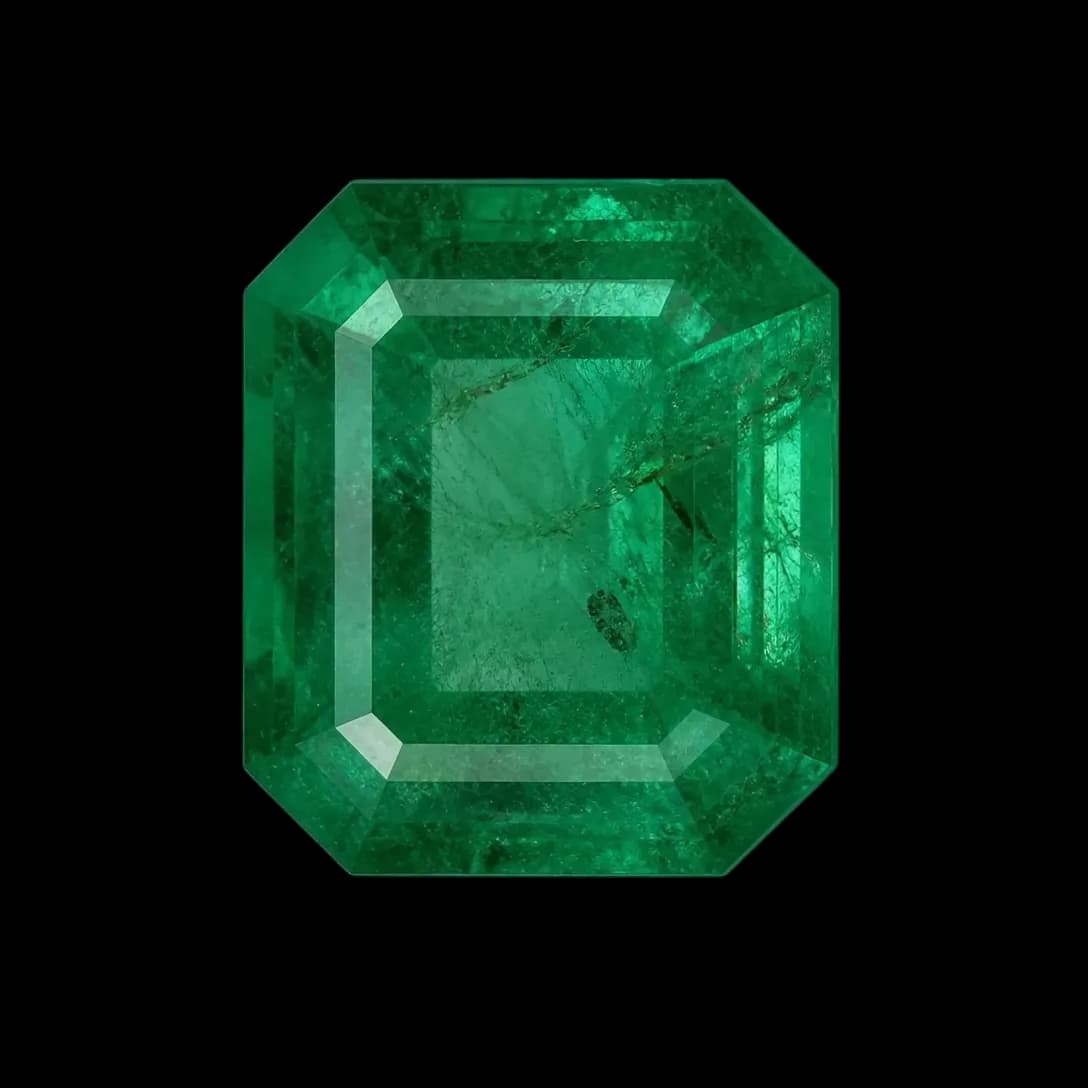
Emerald
The green jewel of royalty, prized for its saturated color above all else.
Emerald is the green variety of the mineral beryl, colored by trace amounts of chromium and sometimes vanadium. It completes the 'big four' precious gemstones alongside diamond, ruby, and sapphire. Unlike other precious stones where clarity is paramount, the trade accepts visible inclusions in emerald. The French term 'jardin' (garden) describes the characteristic internal landscape. Colombian emeralds set the color standard with their pure, vivid green, while Zambian stones are known for a slightly bluish-green hue and superior clarity. Nearly all emeralds are oiled or treated to improve appearance.
What are the properties of emerald?
| Hardness (Mohs) | 7.5–8 |
| Refractive Index | 1.565–1.602 |
| Specific Gravity | 2.67–2.78 |
| Crystal System | Hexagonal |
| Chemical Formula | Be₃Al₂(SiO₃)₆ |
Color Varieties
Major Sources
Colombia · Zambia · Brazil · Ethiopia · Zimbabwe · Afghanistan
What affects emerald price?
Color
The single most important factor. Vivid, saturated green without being too dark or too light commands the highest prices. Colombian 'muzo' green is the benchmark.
Clarity
Eye-clean emeralds are rare and exponentially more valuable. The trade is more tolerant of inclusions in emerald than any other precious stone.
Treatment
Minor oiling is industry standard and expected. Heavily oiled or resin-treated stones are discounted. 'No oil' emeralds from top labs carry massive premiums.
Origin
Colombian origin carries the strongest premium. Zambian emeralds offer excellent quality at lower prices. Ethiopian material is newer to market and more affordable.
How much does emerald cost per carat?
Retail prices as of mid-2026. Actual cost depends on color, clarity, origin, and treatment.
| Quality | Price/ct | Notes |
|---|---|---|
| Commercial | $200–$1,500/ct | Yellowish-green, heavy inclusions |
| Medium quality | $1,500–$6,000/ct | Pleasant green, moderate transparency |
| Fine (rich green) | $5,000–$20,000/ct | Strong saturation, good transparency, minor oil |
| Exceptional (vivid) | $15,000–$60,000/ct | Intense color, strong transparency, minimal oil |
| Collector/Museum | $50,000–$150,000+/ct | Vivid Colombian, no oil, large sizes |
How to care for emerald
Do
- Clean gently with lukewarm soapy water and a very soft cloth
- Store in a padded box away from other jewelry
- Re-oil periodically through a trusted jeweler to maintain appearance
Don't
- Never use ultrasonic or steam cleaners. Emeralds are almost always treated and these methods can damage fillings
- Don't expose to heat or sudden temperature changes
- Avoid harsh chemicals, solvents, and acetone which can strip oil treatment
Cleaning Method
Only use lukewarm soapy water with a very soft cloth. Emeralds are the most fragile of the precious gemstones and require the gentlest care.
How to buy emerald
Accept that inclusions are normal in emerald. Focus on color first, then clarity.
Request a lab report that discloses the level of enhancement (none, minor, moderate, significant).
Zambian emeralds offer the best value for buyers who prefer a slightly bluish-green hue.
Avoid setting emeralds in tension settings or high-exposure ring designs. They chip more easily than other precious stones.
For large emeralds (3+ carats), even moderate inclusions are acceptable if the color is exceptional.
Did You Know?
Cleopatra was famously obsessed with emeralds and claimed ownership of all Egyptian emerald mines.
The Mogul Mughal Emerald, dating to 1695, sold for $2.2 million at Christie's.
Colombia produces roughly 70–90% of the world's fine emeralds.
Frequently asked questions
How much is a 1 carat emerald worth?
A 1 carat emerald typically costs $300 to $10,000+ at retail, as of mid-2026, depending on color, clarity, and treatment level. Commercial stones with visible inclusions start around $200 to $1,500 per carat. Vivid Colombian stones with minor oil and good transparency reach the top of the range.
Why are emeralds so expensive?
Fine emerald rough is scarce, and the trade accepts inclusions that would disqualify other gems. Colombian material with vivid green saturation and usable transparency is limited. Stones certified as no-oil or minor-oil by top labs carry steep premiums because truly clean emerald crystals are rare in nature.
Are emeralds more fragile than diamonds?
Yes. Emerald rates 7.5 to 8 on the Mohs scale versus diamond's 10, and its internal fractures make it more prone to chipping under impact. Diamonds also resist inclusions-related weakness better because eye-clean material is common. Emeralds need protective settings and gentler daily care.
Colombian vs Zambian emeralds: which is better?
Colombian emeralds set the color standard with pure, vivid green and a slight yellow undertone. Zambian stones lean bluish-green and often have better clarity for the price. Neither origin is universally superior; Colombian material commands higher premiums, while Zambian emeralds offer strong color at lower per-carat cost.
What is emerald oil treatment?
Oil treatment fills surface-reaching fractures with colorless oil (traditionally cedarwood oil) to improve clarity and sometimes color appearance. Minor oiling is industry standard and expected on most emeralds. Heavily oiled or resin-filled stones are discounted, and no-oil emeralds from top labs can sell for multiples of treated equivalents.
Related Resources
Related Gemstones
Comparisons
Last updated: 2026-08-12