
Types of Earring Backs: A Complete Guide
Butterfly, screw-back, lever-back, flat-back, La Pousette, clip-on, and more. Comfort, security, and which piercing type each one works with.
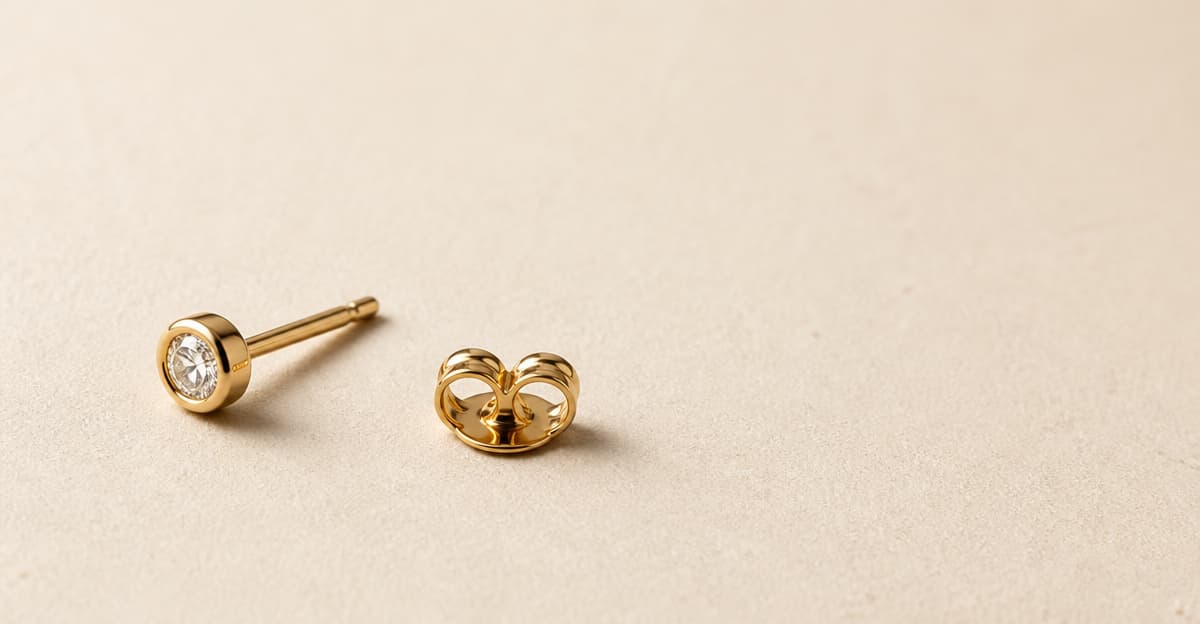
The earring back is the most underrated part of any earring. You spend weeks choosing the perfect diamond studs and then lose one because the $0.10 butterfly back slipped off while you were brushing your hair.
It happens constantly. In a survey by the Jewelers of America (2023), lost earring backs ranked as the number one jewelry frustration after tarnishing. Most of those losses are preventable with a better back type.
Here's every earring back on the market, how each one works, and when to use them.
Butterfly Backs (Push Backs, Friction Backs)
The most common earring back in the world. Two flat metal tabs spring against the post to hold it in place. You push the back onto the post, friction keeps it there, pull it off to remove.
Butterfly backs are cheap to produce, easy to use, and universal. They fit virtually any standard earring post. When new, they grip firmly. The problem is that butterfly backs lose tension over time. The metal tabs spread slightly with repeated use, and after a year or two of daily wear, they start sliding off posts.
For studs under $200, butterfly backs are fine. Replace them annually or whenever they feel loose. For expensive diamond studs, consider upgrading to a screw-back or La Pousette.
Comfort: good. Lightweight and barely noticeable.
Security: medium when new. Degrades to low over time.
Best for: fashion earrings, lightweight studs, everyday pairs you'd replace if lost.
Screw Backs
The post has a threaded end, and the back screws on like a small nut. To fasten, you thread the back onto the post and twist until snug.
Screw backs are the traditional choice for valuable studs. They don't fall off accidentally because the screw mechanism requires deliberate rotation to loosen. Many jewelers default to screw backs on diamond studs over 0.50 carats for this reason.
The downsides are real though. Screwing them on takes time and fine motor control. If you're getting dressed in a hurry, screw backs are annoying. The threading can also cross-thread if you're not careful, making the back wobbly or stripping the post over time.
Our take: screw backs are secure but tedious. If security is your top priority and you don't mind the extra 30 seconds, they're a solid choice.
Comfort: moderate. Slightly heavier than butterfly backs. Can irritate sensitive ears if screwed too tight.
Security: high. Won't come off without deliberate unscrewing.
Best for: valuable diamond studs, gemstone studs, children's earrings (some parents prefer screw backs because kids can't remove them easily).
La Pousette (Guardian Backs)
A spring-loaded mechanism that clips onto the earring post with a satisfying click. Press two small levers on the sides to release. The Guardian brand is the most well-known version.
La Pousette backs solve both problems with traditional backs: they're as secure as screw backs and as fast to use as butterfly backs. Click on, done. No threading, no friction loss. The spring mechanism maintains consistent tension for years.
The catch (always one) is price. Genuine La Pousette or Guardian backs cost $25-80+ per pair depending on metal. That's reasonable for $2,000 diamond studs but overkill for $50 fashion earrings.
Comfort: good. Lightweight for the level of security they provide. Slightly bulkier than butterfly backs but not noticeably so.
Security: very high. Spring-loaded mechanism with positive click engagement. Won't come off unless you squeeze both release levers simultaneously.
Best for: high-value studs where losing one earring would cost hundreds or thousands. The insurance policy your earrings deserve.
Lever Backs
A curved wire loops through the earlobe and a small lever latches shut. The earring hangs from the wire rather than sitting on a post.
Lever backs are self-securing. When the lever is closed, the wire forms a complete loop through your ear. The earring physically cannot fall out. This makes them the most secure option for dangly and drop earrings.
They look elegant. The curved wire becomes part of the earring's design. Many designer earrings use lever backs as a deliberate aesthetic choice.
Comfort: very good. The wire distributes weight along the earlobe rather than concentrating it on one point.
Security: very high. The latching mechanism creates a closed loop. The only way to lose a lever-back earring is if the hinge breaks, which is rare with quality construction.
Best for: drop earrings, dangle earrings, hoop earrings. The default for dangly designs over $100.
Flat Backs (Disc Backs, Labret Backs)
A flat disc sits against the back of the earlobe, attached to a straight post that pushes through from the front. The flat surface distributes pressure evenly and sits flush against the skin.
Flat backs have become the default recommendation from professional piercers in the last five years. The flat surface is more comfortable for sleeping, doesn't snag on hair or pillows, and sits closer to the ear than any other back type.
There are two sub-types. Threaded flat backs have a post that screws into the flat disc (like a screw back but with a disc instead of a nut). Threadless flat backs use a bent pin that pushes into a hollow post and holds by friction and tension.
Comfort: the best. Flat surface means no poking, no digging into the ear, no snagging on hair or clothing. This is why piercers love them.
Security: medium-high for threaded versions. Medium for threadless (the tension-fit can loosen over time, similar to butterfly backs, though it takes longer).
Best for: new piercings (healing piercings need gentle, snag-free backs), cartilage piercings, second and third lobe piercings, and anyone who sleeps on their side. Also great for people who find traditional backs uncomfortable.
Clip-On Backs
A hinged clip squeezes onto the earlobe. No piercing required.
Clip-ons serve people who don't have pierced ears or can't wear post-style earrings. The modern versions have gotten better. Older clip-ons were known for uncomfortable pinching after an hour or two. Current designs use adjustable tension screws and cushioned pads that reduce pressure.
Some clip-ons now look nearly identical to post earrings when worn. The clip mechanism hides behind the earlobe, and unless someone inspects closely, they can't tell.
The tradeoff is always comfort vs. security. A clip-on that grips tightly enough to stay on will eventually get uncomfortable. One that's loose enough to be comfortable all day may slip off. Finding the right tension is personal.
Comfort: varies widely. Good designs with padded clips work for 4-6 hours comfortably. Cheap designs start hurting after an hour.
Security: medium. Dependent on tension adjustment and earlobe shape.
Best for: unpierced ears, people with closed piercings, formal occasions where wearing earrings is expected.
Omega Backs (Omega Clip)
A curved metal piece hinges from the back of the earring and clips over the earlobe from behind. The omega shape acts as both the back and a structural support.
Omega backs are standard on larger stud-style earrings, button earrings, and clip-on conversions. The curved metal distributes weight across a wider area than a single post, which matters for heavy earrings.
On post earrings, an omega back often supplements the post rather than replacing it. The post goes through the piercing for positioning, and the omega clip provides the actual holding force. This combination is very secure and comfortable for heavy pieces.
Comfort: good for heavy earrings. The wide clip distributes weight. Can feel bulky on smaller earrings.
Security: high. The clip mechanism provides strong holding force. Combined with a post, it's one of the most secure configurations available.
Best for: heavy earrings, large studs, button-style earrings. Common on designer and luxury earrings where weight is a factor.
Hinged Backs (Huggie Style)
The earring itself is the closure. A small hoop or partial hoop hinges open, passes through the ear, and clicks shut. Huggie hoops are the most common example.
The entire earring rotates on a hinge and locks with a small click-pin mechanism. There's no separate back to lose. The earring is the back.
Comfort: excellent. Nothing pressing against the back of the ear. The hoop sits flush around the lobe.
Security: high. The click-lock mechanism is reliable, and since there's no separate piece, you can't lose the back.
Best for: small hoop earrings, huggie hoops, everyday earrings you want to put in and forget about.
How to choose
For everyday studs under $200: butterfly backs are fine. Upgrade to flat backs if comfort is important, especially for sleeping.
For diamond studs or anything over $500: La Pousette or screw backs. The cost of the upgrade is negligible compared to losing a $1,000 earring.
For drop and dangle earrings: lever backs. They're secure, elegant, and self-locking.
For new piercings: flat backs, always. Every reputable piercer will tell you the same thing.
For heavy statement earrings: omega backs with a post for stability and weight distribution.
And one universal rule: check your earring backs every few months. Give each one a gentle tug. If it slides off the post without resistance, replace it before you lose the earring. A $5 pack of replacement backs is cheaper than replacing a $2,000 diamond stud.
Shopping for diamonds to put in those earrings? Check current market prices with our diamond price estimator, or see how much a 2 carat diamond actually costs in 2026. For bracelet closures, we have a matching guide to every type of bracelet clasp with security ratings.