Ruby
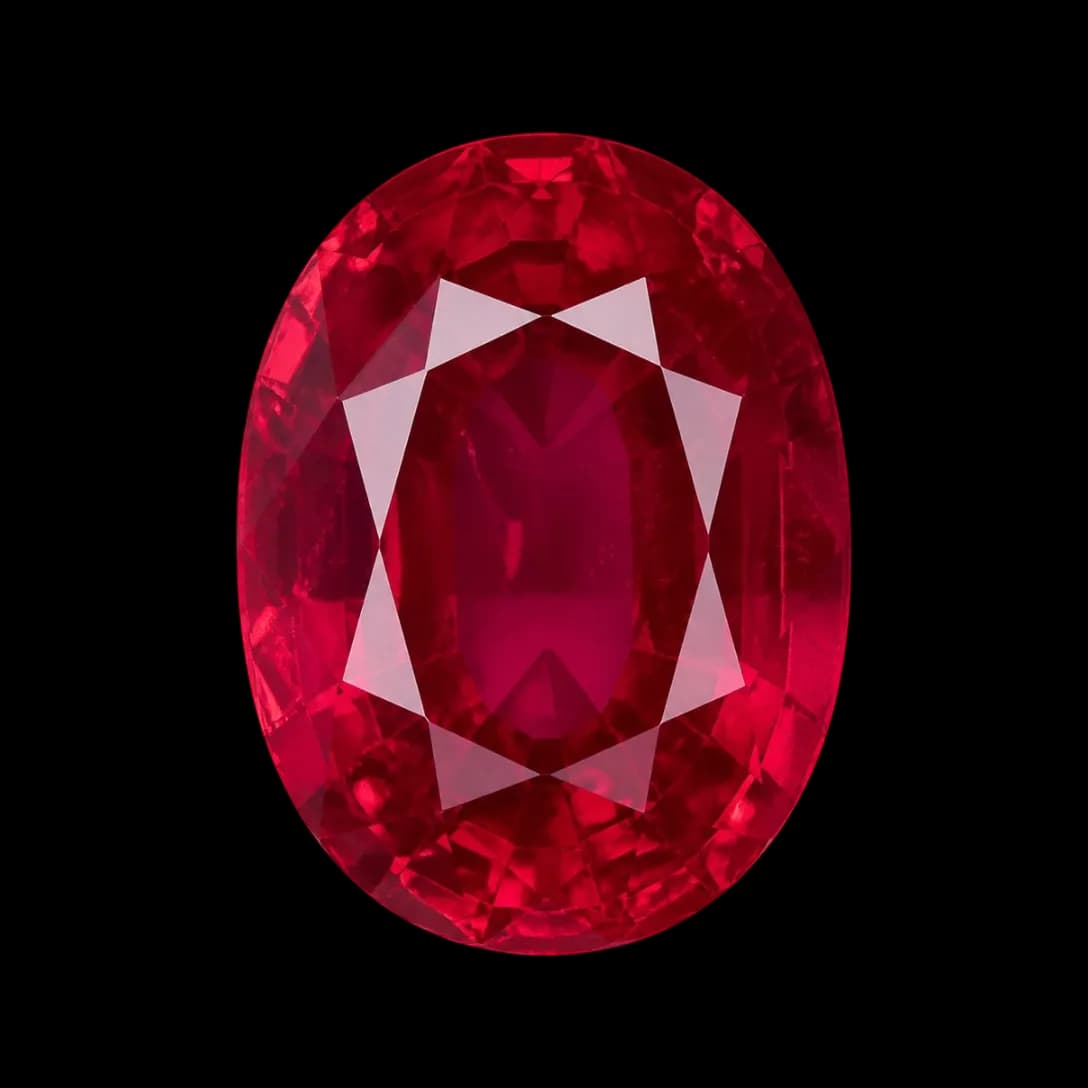
The king of colored gemstones, valued for its vivid red brilliance.
Ruby is the red variety of the mineral corundum (aluminum oxide), with its color caused by trace amounts of chromium. Along with diamond, emerald, and sapphire, ruby is classified as one of the four precious gemstones. Top-quality rubies, particularly those from Myanmar (Burma), can exceed diamonds in per-carat price. The most desirable color is a saturated, medium-dark red known in the trade as 'pigeon blood.' Heat treatment to improve color and clarity is standard practice and accepted by the industry.
What are the properties of ruby?
| Hardness (Mohs) | 9 |
| Refractive Index | 1.762–1.770 |
| Specific Gravity | 3.97–4.05 |
| Crystal System | Trigonal |
| Chemical Formula | Al₂O₃ (with Cr) |
Color Varieties
Major Sources
Myanmar (Burma) · Mozambique · Madagascar · Thailand · Sri Lanka · Tanzania
What affects ruby price?
Color
The primary value driver. 'Pigeon blood' (a vivid, saturated red with a hint of blue) commands the highest premiums. Stones that are too dark or too pink are discounted.
Origin
Burmese rubies are the most valued. Mozambique has emerged as a major source producing fine-quality material. Origin is documented on lab reports.
Treatment
Unheated rubies command 30–100%+ premiums over heated equivalents. Lead-glass filling dramatically lowers value and durability.
Clarity
Rubies are Type II gems. Some inclusions are expected. 'Eye-clean' stones are rare and premium. Silk inclusions can create desirable star effects.
How much does ruby cost per carat?
Retail prices as of mid-2026. Actual cost depends on color, clarity, origin, and treatment.
| Quality | Price/ct | Notes |
|---|---|---|
| Commercial (heated) | $300–$1,200/ct | Standard heated, visible inclusions, 1-2ct |
| Fine (heated, good clarity) | $2,000–$6,000/ct | Vivid red, eye-clean, heated, 1-2ct |
| Top (pigeon blood) | $7,000–$15,000/ct | Vivid pigeon blood color, 1-2ct |
| Investment (unheated Burma) | $20,000–$100,000+/ct | Unheated Mogok, certified, 1ct+ |
| Auction record | $100,000–$1,000,000+/ct | Museum-grade pigeon blood, 3ct+ |
How to care for ruby
Do
- Clean with warm soapy water and a soft brush
- Safe for ultrasonic cleaning (if not fracture-filled or heavily included)
- Store in a soft pouch to prevent scratching softer stones
Don't
- Never use ultrasonic or steam on lead-glass-filled rubies
- Avoid harsh chemicals and sudden temperature changes
- Don't assume all rubies can be treated the same. Check treatment disclosure
Cleaning Method
Warm soapy water is universally safe. Ultrasonic and steam are fine for untreated or heat-only treated rubies, but dangerous for fracture-filled or glass-filled stones.
How to buy ruby
Always request a lab report from GIA, Gübelin, or SSEF that discloses treatment and origin.
Mozambique rubies offer excellent quality at lower per-carat prices than Burmese stones.
Heat-treated rubies are industry standard and offer great value. The premium for unheated is often unjustified unless you're collecting.
Avoid lead-glass-filled rubies for fine jewelry. The glass can deteriorate over time.
In smaller sizes (under 1 carat), rubies offer dramatically better value than in larger sizes where prices escalate steeply.
Did You Know?
Ancient warriors believed rubies granted invincibility in battle.
The 'Sunrise Ruby' sold for $30.3 million in 2015, making it the most expensive ruby ever auctioned.
Ruby and sapphire are the same mineral, corundum. Only red corundum qualifies as ruby.
Frequently asked questions
How much is a 1 carat ruby worth?
A 1 carat ruby ranges from $300 to $100,000+ per carat at retail, as of mid-2026. Most commercial heated stones land between $300 and $6,000 per carat. Top pigeon blood or unheated Burmese stones with lab reports from GIA, Gübelin, or SSEF sit at the high end.
What does pigeon blood ruby mean?
Pigeon blood is a trade term for the most desirable ruby color: vivid, saturated red with a slight bluish undertone, neither too dark nor too pink. Gübelin and SSEF use it on reports for stones that meet their color standard. It does not describe a specific mine or origin, though Burmese Mogok rubies most often earn the label.
What is the difference between heated and unheated ruby?
Heat treatment dissolves rutile silk and improves color and clarity. It is permanent, stable, and accepted as standard practice in the trade. Unheated rubies with comparable color and clarity carry 30% to 100%+ premiums because untreated material of that quality is genuinely scarce.
Are rubies more expensive than diamonds?
At the top end, yes. Fine unheated Burmese pigeon blood rubies regularly exceed diamond per-carat prices above 1 carat. Commercial heated rubies in the $300 to $6,000 range are far cheaper per carat than equivalent-quality diamonds. The comparison depends entirely on color grade, origin, and treatment status.
Ruby vs sapphire: what is the difference?
Both are corundum. Ruby is red corundum colored by chromium; sapphire is every other corundum color, most commonly blue from iron and titanium. They share the same 9 Mohs hardness and crystal structure. Rubies generally command higher per-carat prices at equivalent quality because fine red material is rarer than fine blue.
Related Resources
Related Gemstones
Diamond
The hardest natural substance and the benchmark of the gemstone world.
Garnet
A family of gems spanning every color, not just the deep reds.
Sapphire
Corundum in every color except red, the most versatile precious stone.
Spinel
The great imposter, historically mistaken for ruby and sapphire, now prized in its own right.
Last updated: 2026-08-12